Fall Migration Devil’s Sinkhole and Frio
Here we see what looks like the fall migration of Mexican free-tailed bats from Devil’s Sinkhole and Frio caves in Central Texas.
A 17 deg F drop in temp at dusk along with a 26 deg F drop in dew point seem to be the trigger.
We see them travel 100 miles SSW to the irrigated fields of Los Alamos, outside of Allende, Coahuila before they disperse.
They traveled about 116 miles in two hours, not the world speed record for mammals (99 mph) that the Frio bats hold, but not too shabby (58 mph). They seem to be headed toward Cueva de la Virgen in Coahuila, a cave historically known to hold 350,000 Tadarida and 10,000 cave myotis. We’d love to know if anyone is monitoring numbers at that cave and whether there is a big spike in numbers today and for how long. If numbers surge there, will they stay all winter, or will numbers wane as they move further south?
Austin meteorological conditions at emergence are in a chart below the video.

Our radar video on the Today Show.
The Today Show came to visit Congress Ave Bridge and Bracken Cave for a story on Bat Tourism.
Featured is our Mexican free-tailed bat Freida and included is our radar video of the Bracken bats.
Too bad they didn’t credit us for either one of these!
Secretive Tri-colored
This tri-colored bat is very secretive and hard to find in the aviary. So how come they hang in such conspicuous spots in apartment complexes?


French Public Radio visits Austin Bat Refuge
Here’s an insightful interview of Dianne Odegard, Co-Founder of Austin Bat Refuge, in her flight cage, conducted by the wonderful Cerise Marechaud, free-lance audio-journalist for French Public Radio, Swiss Public Radio, and many more.
Super interesting to hear Cerise interpreting Dianne’s commentary into French.
Follow Cerise on SoundCloud at https://soundcloud.com/cerisemarechaud
Here’s the version with Dianne in her flight cage.
And here’s the version of the interview conducted in June, embedded in a cool Swiss music program, which aired on Aug 29, 2016.
http://www.rts.ch/play/radio/detours/audio/des-chauve-souris-et-des-hommes?id=7940616
Gabe, the Leader of the Bat Pack
Gabe, the Leader of the Bat Pack, howls to proclaim his dominance over all he surveys!
He wowed over 5,000 students in an on-line Distance Learning event at the Texas Wildlife Association.
Their Halloween annual with our bats, called Bats-a-Billion, is their biggest online event of the year every year.
In addition to Gabe, we brought Buffy (a northern yellow bat), Zonker (an evening bat), and Buddy (a Mexican free-tailed bat).
They are all good bats!
Tri-colored South Austin
Here’s a beautiful tri-colored female that had been roosting in a stairwell landing on the second story of an apartment building in South Austin. She was in the same place for about a week with no sign that she had been able to fly or feed. Her location made her vulnerable to maintenance workers or perhaps a fearful apartment dweller with a broom.
Wildlife lovers Sonja Peterson and Thanh Vo had been checking on her and were worried that she had not seemed to move for a long time. They were relieved to finally see her stretch her wings a few days back, but were concerned that she might be injured and unable to feed herself. So we went to look and spotted her immediately when we pulled up to the building. We plucked her off the wall (with gloves on) and brought her back to check her out in the flight cage.
Her wings were beautiful, no spotting, no tears, no broken bones.

We checked her out under UV light and no florescence showed up that would indicate Pd, the fungus that causes White-nose Syndrome.

She flew right off when given the opportunity and we watched as she did about six laps around the aviary. This is way more continuous flight than the last tri-colored we took in a few days ago.


So this leaves us to wonder why she would roost in such an exposed location, vulnerable to any humans walking by or even grackles which could easily spot her against the white stucco.
Most of our tri-colored bats come to us from the upper levels of apartment buildings that have open-ended corridors leading to the various apartments. We think the bats consider these to be open-ended caves and feel quite at home there. At this time of year both sexes of tri-coloreds should be swarming at cave mouths and mating, the females storing sperm for spring births. Is it possible this bat is misplaced and hanging around wondering where the guys are?
We’ll feed her up and then bring her back to the same area and hope she finds a real cave to get her back on track.
Check out our local species info page: https://austinbatrefuge.org/tri-colored-bat/
Sonja and Thanh are doing great work with the feral cats around their apartment. Thanks to them this bat and all other wildlife will fare much better in their area. Thanks for caring Sonja and Thanh!
Tri-colored sonogram / sounds of silence
So our tri-colored bat checks out clean under the black light, no orange fluorescence, no spotting in normal light, we think she’s clean for Pd, no White-nose Syndrome.
She’s not sustaining flight however. She flew the length of the flight cage once but landed and has only taken short flights since then. It is said that they are sporadic flyers with a short elliptical flight patterns, so this may be normal. But she did not fly away when she had the opportunity as we were collecting her, so we’ll need to check her out some more to make sure she has the strength a bat needs to survive in the wild.
On the left is the recording of her call as she made that one flight down the length of the flight cage. On the right is a call from the reference library of a tri-colored bat in Mammoth Cave State Park in Kentucky from back in 2007. Tragically, tri-colored bats in that area have been decimated by White-nose Syndrome, numbers have plummeted 80% since it’s arrival in 2013 and that song is likely not heard very often in that area nowadays. How sad to think of all the bats that have perished from this terrible disease. And awful to think we’ll likely be dealing with it ourselves in a year or two.
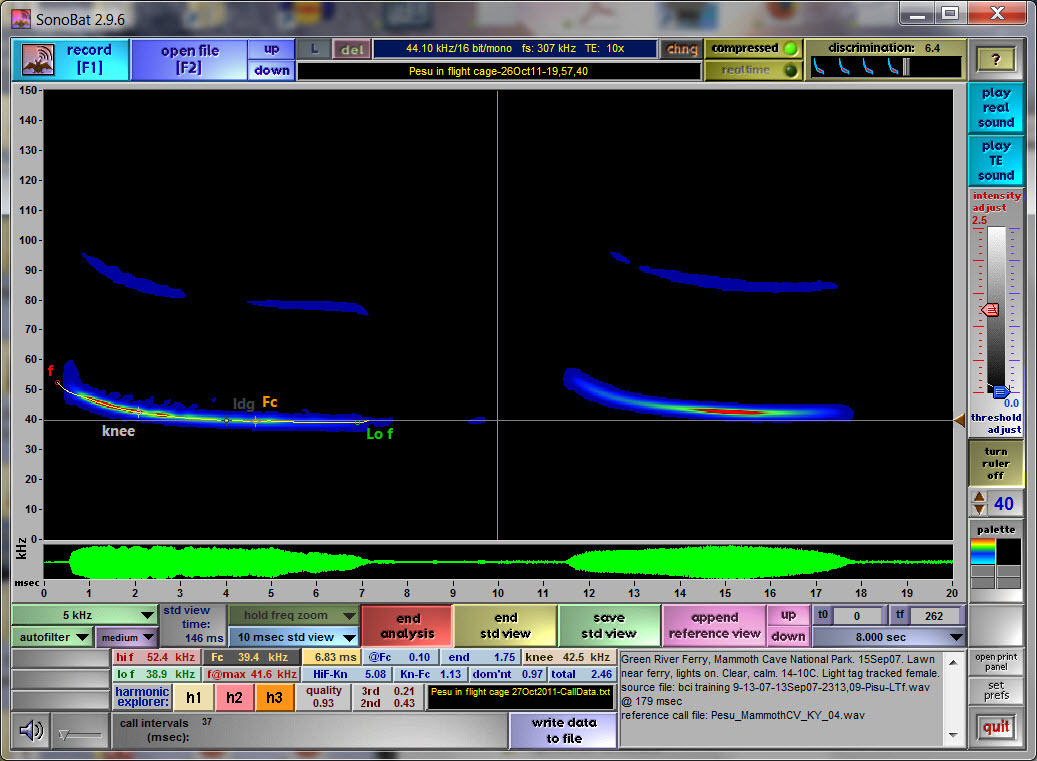
She weighs 8 grams! So surprising that a tiny bat would weigh so much. She looks about the same size as our evening bat Zonker, not way smaller as we would have expected.
Tri-colored bat – North Austin
This tri-colored bat was hanging in an apartment building 2nd story hallway in North Austin for the past few days.
She hadn’t left to forage and was soon to attract attention from the maintenance staff, so our good friend Ed Sones brought her in. She showed just how quick a tri-colored bat can be when Ed was collecting her, but did not fly away, so we’ll need to check for wing damage once she gets more accustomed to us.
Almost all our tri-colored bats come from apartment building hallways on the upper levels. They must think these open ended hallways are just another cave and perfectly suitable for them; and they would be if it weren’t for all those pesky humans!
Her orange forearms, tiny size, pointy nose, and longer ears all indicate Perimyotis subflavus, formerly Pipistrellus subflavus, commonly known as Tri-colored bat, formerly Eastern Pipistrelle. Whew, they sure do make it complicated!
Check out her range and species info on our webpage https://austinbatrefuge.org/tri-colored-bat/
Shoal Creek Conservancy Bat Walk
We had a great time last night conducting a Bat Walk to mark the third anniversary of the founding of Shoal Creek Conservancy, here in Austin.
Bat fans showed up on the second night of cool weather to see if bats would fly from under the 9th St. Bridge in Duncan Park.
Though the cool weather felt great to us after a long extended hot summer, the bats were snug in their expansion-joint crevices under the bridge and did not want to drop out into the cool night. The temperature had dropped to 43 degrees F the previous night and that night’s dew point of 47 F promised another cool night ahead. Since fewer insects fly below 50 F, they must have decided to conserve their energy budget and stay snug in the roost. Here’s a thermal imaging snapshot of the crevice we inspected.
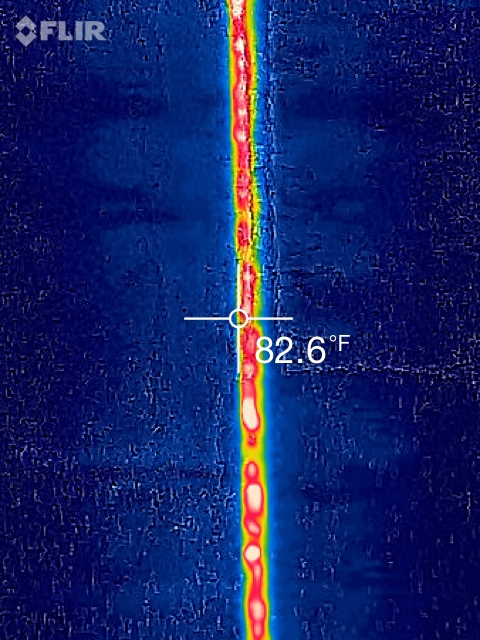
Those are bat bodies showing white and their reading was about 88 deg F on the outside of their fur. Their body heat kept the crevice nice and warm, 82.6 deg F here next to the bats in this snapshot, 15 degrees warmer than the blue-colored bridge outside the crevice. It would take a lot of snuggling to re-create all that warmth, so perhaps they just hunkered down to wait out the cooler nights. Low temps will be back in the 60s for the next two weeks, so I think they made the right call.
Great group of people at Shoal Creek Conservancy; we’re so happy there is a unified voice to speak up on behalf of beautiful Shoal Creek!
Thanks to all who came out to hear our talk and watch our radar images of Central Texas bat activity. Next year we’ll unveil the new SonoBat Live and if we get a warmer night, we’ll all be able to see real time sonograms of the echolocation calls of flying bats.
Checkin in
You doin ok in your log Zonker? Just checkin, good bat.